
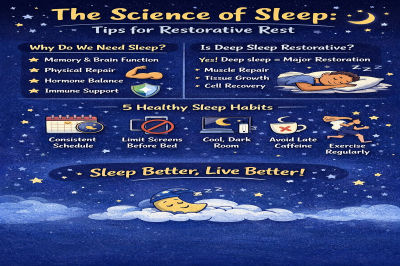
The Science of Sleep: Tips for Restorative Rest

Admin
Blog AuthorYou can drink all the coffee you want, but if your sleep sucks, your day will too. I learned that the hard way after a week of “I’ll just watch one more episode.†Spoiler: I did not watch one more episode. I watched five, felt like a zombie, and questioned all my life choices by 9 a.m.
So let’s fix that.
Today, we’re talking about the science of sleep, how it actually works, and how you can use simple, realistic strategies to get truly restorative rest. Not the “I technically slept†kind. I mean the wake-up-feeling-like-a-functional-human kind.
What Is the Science of Sleep Called?
First things first.
If you’ve ever asked, “What is the science of sleep called?â€, the answer is somnology. Yes, that’s a real word. It sounds fancy, but it simply means the scientific study of sleep.
Scientists in this field study:
Brain activity during sleep
Sleep cycles and circadian rhythms
Sleep disorders
The effects of sleep on memory, mood, and physical health
And if you’ve ever wondered, “Why do we need sleep scientifically?â€, here’s the short version:
Your brain consolidates memories
Your body repairs tissues
Your hormones reset
Your immune system strengthens
In other words, sleep keeps you alive and functional. Not dramatic—just facts.
Why Do We Need Sleep Scientifically?
Let’s break this down in simple terms.
Your body runs like a high-performance machine. During the day, you burn energy, solve problems, scroll social media (obviously), and deal with stress. At night, your body runs maintenance mode.
Here’s what actually happens:
Brain Cleanup Crew
While you sleep, your brain clears out waste products. Think of it as a nightly deep clean. Without sleep, that “mental clutter†builds up, and you feel foggy and unfocused.
Ever notice how everything feels harder after a bad night’s sleep? That’s not in your head. Well… technically, it is.
Physical Repair
Your body releases growth hormone during deep sleep. That hormone:
Repairs muscle
Strengthens bones
Supports immune health
So yes, sleep helps you recover from workouts. It also helps you recover from life.
Emotional Regulation
Sleep stabilizes mood. When you skip sleep, your emotional control drops. Suddenly, minor inconveniences feel like personal attacks.
Is that email really rude? Or did you just sleep four hours?
Exactly.
Is Deep Sleep Restorative?
Short answer: Yes. Extremely.
Deep sleep, also called slow-wave sleep, gives you the most physical restoration. When people ask, “Is deep sleep restorative?â€, the answer is a confident yes.
During deep sleep:
Your heart rate slows
Blood pressure drops
Muscles fully relax
Tissue repair increases
If REM sleep helps your brain process emotions and memories, deep sleep helps your body rebuild.
When I started tracking my sleep, I noticed something interesting. Even if I slept 8 hours, I felt terrible when my deep sleep time dropped. Hours matter—but sleep quality matters more.
Understanding Sleep Hygiene (And Why It’s a Game-Changer)
Let’s talk about something that sounds boring but works wonders: sleep hygiene.
Sleep Hygiene Definition
The sleep hygiene definition refers to habits and practices that help you sleep better consistently.
That’s it. No magic pills. No complicated rituals. Just smart habits.
A lot of sleep hygiene articles overcomplicate things. They throw 40 tips at you and expect you to become a monk by bedtime. Relax. We’ll keep this practical.
10 Healthy Sleep Habits That Actually Work
Here’s your realistic list of 10 healthy sleep habits you can start tonight.
1. Keep a Consistent Sleep Schedule
Go to bed and wake up at the same time every day.
Yes, even on weekends.
Your circadian rhythm loves consistency. When you stick to a schedule, you fall asleep faster and wake up easier.
2. Create a Wind-Down Routine
Your brain needs signals that say, “We’re shutting down.â€
Try:
Reading
Stretching
Light journaling
Soft music
Scrolling TikTok does not count. Sorry :/
3. Limit Blue Light Before Bed
Screens delay melatonin production.
Turn off devices at least 30–60 minutes before bed. If you can’t, use night mode and dim the brightness.
4. Keep Your Room Cool and Dark
Your body sleeps better in a slightly cool environment.
Aim for:
60–67°F (15–19°C)
Blackout curtains
Minimal noise
5. Avoid Late Caffeine
Caffeine can stay in your system for 6–8 hours.
If you struggle with sleep, cut it off by early afternoon. FYI, that “harmless†5 p.m. coffee might sabotage you.
6. Exercise Regularly
Exercise improves sleep depth and quality.
Just avoid intense workouts right before bed. Your nervous system needs time to calm down.
7. Avoid Heavy Meals Late at Night
Big meals force your digestive system to work overtime.
Keep dinner light if you eat close to bedtime.
8. Use Your Bed for Sleep Only
Train your brain to associate your bed with rest.
Not work. Not Netflix marathons. Not doom-scrolling.
9. Get Morning Sunlight
Sunlight resets your circadian rhythm.
Step outside within 30 minutes of waking up. Even 10 minutes helps.
10. Manage Stress Before Bed
Unmanaged stress kills sleep quality.
Try:
Deep breathing
Gratitude journaling
Writing tomorrow’s to-do list
Why lie awake replaying the day when you can write it down and move on?
Your Simple Sleep Hygiene Checklist
Want something quick and actionable? Here’s a practical sleep hygiene checklist you can screenshot.
☠Fixed bedtime and wake time
☠No caffeine after 2–3 p.m.
☠30-minute wind-down routine
☠Dark, cool bedroom
☠No screens before bed
☠Morning sunlight exposure
☠Regular exercise
You don’t need perfection. Aim for consistency. Even improving 3–4 of these habits can transform your sleep quality.
Comparing Sleep Quantity vs. Sleep Quality
People obsess over “8 hours.†But IMO, that number misleads people.
Here’s the truth:
Sleep quantity = total hours slept
Sleep quality = how restorative those hours are
You can sleep:
8 hours with poor deep sleep → feel exhausted
6.5–7 solid hours with strong deep sleep → feel energized
If you constantly ask, “Why do I feel tired even after sleeping?†check your habits, not just the clock.
The Role of Circadian Rhythm
Your circadian rhythm controls your sleep-wake cycle.
It responds to:
Light exposure
Meal timing
Activity levels
When you stay up until 2 a.m. under bright lights, you confuse your internal clock. Then you wonder why you feel wired at midnight and dead at 8 a.m.
You can’t fight biology forever. Biology wins.
Common Sleep Mistakes I Used to Make
Let me be honest.
I used to:
Drink coffee at 6 p.m.
Scroll in bed for an hour
Sleep at random times
Skip morning sunlight
Then I complained about poor sleep. Brilliant, right?
Once I fixed just three habits consistent bedtime, no late caffeine, and morning light my energy improved within two weeks.
Small changes. Huge impact.
Supplements and Sleep: Do You Need Them?
People love quick fixes.
Melatonin can help short term, especially for jet lag. But you should not rely on it long term without addressing habits.
Always fix:
Schedule
Light exposure
Stress levels
before adding supplements.
Otherwise, you put a bandage on a lifestyle problem.
Why Sleep Hygiene Beats Hacks
Biohacks sound cool.
Cold plunges. Fancy devices. Expensive sleep trackers.
But basic sleep hygiene beats most hacks.
Consistent schedule > random sleep times
Dark room > LED chaos
Morning sunlight > blackout cave lifestyle
Simple works. It just requires discipline.
Final Thoughts: Make Sleep Your Superpower
Here’s the deal.
The science of sleep shows us one clear truth: restorative sleep fuels everything focus, mood, metabolism, and long-term health.
If you want to feel sharper, calmer, and stronger, fix your sleep first.
Start small:
Improve 3 habits from the checklist
Protect your bedtime like an appointment
Respect your circadian rhythm
You don’t need perfection. You need consistency.
Tonight, ask yourself: do I want another tired morning… or do I want to wake up feeling powerful?
Your pillow waits. Choose wisely.